
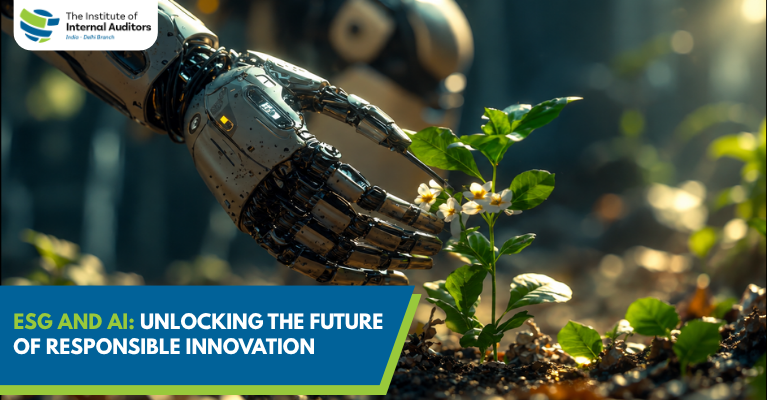
“AI isn’t just teaching cars to drive—it’s teaching companies to think. From climate risks to supply chains, ESG decisions are getting a digital co-pilot.”
Introduction
The global Environmental, Social and Governance (ESG) landscape has transformed from routine compliance into a core driver of business strategy and growth. What was once viewed as a box-ticking exercise is now central to boardroom agendas, shaping investment decisions and stakeholder engagement. According to recent reports,[1]organisations are shifting their focus from simple compliance to active value creation. ESG is no longer just about satisfying regulations; it’s about driving innovation, building a more resilient enterprise, and earning a competitive edge in a volatile market. This shift is happening on a global scale, fuelled by a new wave of mandatory reporting standards and a growing demand for transparency from investors and customers.
At the heart of this change lies a powerful convergence: Environmental, Social, and Governance (ESG) and Artificial Intelligence (AI). Rather than treating ESG and AI as parallel conversations, organizations now recognize that they are deeply interdependent. AI can provide the intelligence, speed, and scalability needed to advance ESG commitments, while ESG frameworks supply the ethical guardrails that prevent misuse and ensure that innovation aligns with social and environmental priorities. Together, they can redefine how businesses build trust, deliver value, and prepare for a resilient future.
Why AI Matters for ESG
AI offers unique capabilities that can accelerate ESG in ways traditional methods cannot. Think of ESG as the seed and digital technologies as the ecosystem. AI processes complex datasets, reveals hidden patterns, and generates predictive insights for faster, smarter decisions. IoT sensors monitor energy, water, and emissions in real time, while blockchain secures supply chain traceability and validates sustainability claims. With the rise of generative AI, companies can now simulate climate risks, automate ESG reporting, and even design low-carbon products with unprecedented speed.

Environmental
AI models can monitor emissions, predict climate risks, and optimize resource use. For instance, predictive maintenance in manufacturing using AI reduces energy use and prevents unnecessary waste. Some companies like Siemens[2], use AI to cut urban water leaks by 50% and speed detection from days to hours. Its tools align water treatment with renewable energy, reducing costs and emissions. Additionally, Siemens applies AI-powered generative design to re-engineer components—such as robot grippers—achieving 84% fewer parts, 90% lighter weight, and savings of up to 3 tons of CO₂ per robot annually. BMW[3] leverages AI to cut energy use, emissions, and waste across its operations. In Munich, AI-driven building systems save 1,200 MWh annually, while digital optimization across German sites reduces CO₂ and energy bills by 10%. AI in vehicles improves efficiency and extends EV range, supporting BMW’s 2030 fleet emissions target. In manufacturing, AI boosts predictive maintenance and resource efficiency, reducing downtime and waste by 15%. Through AI-powered supply chain monitoring, BMW also aims for 40% Scope 3 emission cuts by 2030.
The U.S. Department of Energy[4] estimates that AI-powered optimization of energy grids could free up 100 GW of transmission capacity within five years, equivalent to about 13% of peak demand. AI-powered microgrid management systems are enabling off-grid communities in Southeast Asia and Africa[5] to optimize renewable energy generation and consumption. Predictive algorithms balance demand with solar or wind supply, cutting reliance on diesel generators and reducing carbon footprints.
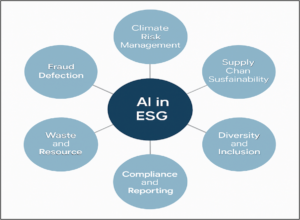
Fig – AI adoption in ESG
Social
AI-powered analytics can uncover trends in workforce diversity, pay equity, and employee well-being. In Australia, Commonwealth Bank[6] deploys AI to block hundreds of thousands of abusive payment messages annually, protecting vulnerable customers from financial abuse. Meanwhile, AI-driven assistive technologies like Be My Eyes improve accessibility for people with disabilities by enabling them to connect with company representatives for real-time support, thus promoting diversity and inclusion. In the “Project Anaemia” initiative in Valsad, India, global consulting firm ZS[7] leveraged AI, automation, and advanced data analytics to enhance rural healthcare delivery. Partnering with a local trust, the program improved data quality, reduced patient check-up time by 15%, increased repeat visits by 50%, and achieved a 30% improvement in patient outcomes—benefiting approximately 83,000 individuals, including women, children, and expectant mothers. Manipal Health[8] Enterprises implemented MiPAL, an AI-based virtual assistant by Leena AI, to automate employee HR inquiries—from payslips and leave to tax and policy questions. This innovation reduced resolution time from 2 days to 24 hours, cut new hire attrition by up to 5% annually, and saved the HR team over 60,000 work hours, significantly improving employee experience and organizational efficiency.
In India[9] and sub-Saharan Africa[10], AI-driven platforms are empowering smallholder farmers with real-time weather forecasting, soil health analysis, and crop yield predictions. By optimizing water and fertilizer use, these tools directly support SDG 2 (Zero Hunger) and SDG 13 (Climate Action), while improving rural livelihoods.
Governance
Companies are using AI to strengthen corporate governance by improving decision-making, risk management, compliance monitoring, board operations, and organizational transparency. Generative AI drafts reports, summarize meeting outcomes, and automate preparation of key board documents, allowing board members to focus on thoughtful discussion and forward-looking decisions. According to KPMG[11], with over 1,000 discrete ESG metrics across jurisdictions, the ability of AI to standardize, validate, and present data transparently is indispensable for global companies juggling complex regulatory requirements such as EU’s CSRD, India’s BRSR, and the U.S. SEC climate rules. GaiaLens[12], a UK-based consultancy, is leveraging AI to uncover instances of greenwashing among public companies. Its platform scans global media and publicly available data to assess whether companies are truly delivering on their ESG commitments. This AI-driven monitoring supports investor scrutiny, enhancing transparency and accountability in corporate sustainability claims. Elsewhere, in partnership with AWS, Capgemini[13] developed a cutting-edge AI-based anomaly detection solution for a major insurer. This system automatically flags discrepancies in ESG data—such as outlier metrics in energy use or carbon reporting—improving data accuracy while reducing manual review efforts by 50%.

The ESG Practitioner’s Role in AI Integration
ESG practitioners are emerging as key enablers of responsible AI adoption, ensuring that sustainability, ethics, and long-term value creation remain central to corporate innovation strategies.
In the new landscape of ESG and AI, practitioners are shifting from strategic advisors to hands-on implementers who directly guide the integration of AI tools across an organization’s processes. Their role is to ensure AI models are trained on accurate ESG data, including Scope 3 supply chain emissions and social metrics from employee surveys. By partnering with operations teams, they can apply AI to automate complex reporting and use predictive analytics to forecast sustainability risks. This allows companies to use AI to optimize resource consumption, directly impacting Scope 1 and 2 emissions and transforming sustainability goals into tangible, data-driven outcomes.
The AI Impact Navigator developed by the Australian National AI Centre[14] provides ESG teams with practical steps to assess how AI affects corporate transparency, workforce well-being, community trust, and consumer rights.
Balancing Innovation and Responsibility
The adoption of AI is not without risks. Poorly designed AI can perpetuate existing inequalities. Large-scale data collection raises cybersecurity and consent issues. Training large generative AI models consumes massive amounts of energy and water. To address these, organizations must embed Responsible AI (RAI) principles into ESG strategy, like, Human-Centred design, Transparency and Explainability, Privacy and Security, Accountability across the AI lifecycle. Boards and leadership teams must also upskill in AI literacy to provide effective oversight, ensuring that innovation supports, not undermines, sustainability goals. Global business leaders increasingly see AI and ESG as top investment priorities. KPMG’s 2023 India CEO Outlook[15] found that 54% of Indian CEOs have fully embedded ESG into strategy, and AI is viewed as a critical enabler of growth.
The convergence of ESG and AI will accelerate Real-time ESG monitoring and will become standard just like financial reporting. AI-assisted climate strategies will help companies design net-zero roadmaps that are cost-efficient and credible. Cross-sector coalitions will emerge, leveraging AI to solve global sustainability challenges, from biodiversity protection to just energy transitions.
Organizations that embrace this synergy will not only comply with regulation but will unlock new value streams, attract sustainability-minded investors, and build long-term resilience.
Conclusion
AI and ESG are not mutually exclusive, they are complementary forces shaping the next chapter of business transformation. AI provides the intelligence and scalability to address complex ESG challenges, while ESG ensures that this innovation is purposeful and aligned with core business values.
The message is clear for corporate leaders: businesses that strategically integrate AI with their ESG frameworks will gain a distinct competitive advantage. They will become leaders in trust, resilience, and operational efficiency. By leveraging AI to optimize resource use, streamline reporting, and identify new market opportunities, these companies will set the standard for responsible growth. The future of ESG and AI isn’t about balancing profit with responsibility. It’s about redefining profit itself by embedding responsibility into the corporate strategy. This isn’t just a vision—it’s the blueprint for the next era of successful, sustainable business!
About the Author
Jyoti Singh

Jyoti Singh is a professional with extensive experience of over two decades in research, training and consulting internal audit, corporate governance, risk management and sustainability domains. She has authored research papers and thought-leadership articles and conducted Certificate courses and trainings. She is also a speaker at various forums – ICAI, ICSI, IIA and C&AG and a member of the FICCI Environment & Sustainability Committee, QCI ESG Advisory Committee and a UNGC India Certified Train the Trainer on BRSR.
Yukti Arora

[1] https://kpmg.com/xx/en/our-insights/esg/the-move-to-mandatory-reporting.html
[2] https://assets.new.siemens.com/siemens/assets/api/uuid:920c58c5-1b3f-4280-84a3-6e58f02f68e5/A-New-Pace-of-Change-Report.pdf
[3] https://www.analyticssteps.com/blogs/how-bmw-uses-artificial-intelligence-ai, https://www.press.bmwgroup.com/global/article/detail/T0449729EN/artificial-intelligence-as-a-quality-booster?language=en
[4] https://www.energy.gov/sites/default/files/2024-04/AI%20EO%20Report%20Section%205.2g%28i%29_043024.pdf
[5] https://energycatalyst.ukri.org/news/advancing-off-grid-energy-access-in-africa-how-ai-and-digital-technologies-are-redefining-the-frontier
[6] https://www.industry.gov.au/sites/default/files/2024-10/ai-and-esg-an-introductory-guide-for-esg-practitioners.pdf
[7] https://economictimes.indiatimes.com/small-biz/sme-sector/how-ai-is-making-the-poor-healthier-a-consulting-firm-shows-the-way-to-close-the-gaps-in-healthcare-services/articleshow/112670371.cms
[8] https://medium.com/%40seekmeai/how-ai-is-transforming-human-resources-case-studies-ab60b15cfd15
[9] https://www.weforum.org/stories/2024/01/how-indias-ai-agriculture-boom-could-inspire-the-world
[10] https://cordis.europa.eu/article/id/459586-climate-smart-solutions-for-african-farmers-using-ai
[11] https://assets.kpmg.com/content/dam/kpmgsites/in/pdf/2024/08/esg-in-the-age-of-ai.pdf.coredownload.inline.pdf
[12] https://www.theaustralian.com.au/business/technology/gaialens-unleashes-ai-to-combat-corporate-greenwashing/news-story/3cfe762870dbac908bda460a7c48c4e1
[13] https://www.capgemini.com/news/client-stories/enhancing-esg-data-integrity-and-efficiency
[14] https://www.industry.gov.au/sites/default/files/2024-10/ai-and-esg-an-introductory-guide-for-esg-practitioners.pdf
[15] https://kpmg.com/in/en/insights/2023/10/kpmg-2023-india-ceo-outlook.html